52: The Class Matrix by Vivek Chibber
The Class Matrix: Social Theory After the Cultural Turn by Vivek Chibber was originally published in 2022 and covers the post-70s transition from dialectical materialism to post-modernism through the atomization and resignation of the working class.
Good god, what am I even talking about? DO NOT FEAR *biblically accurate angel version of me descends into your screen*.

I will happily break this down, just as Chibber does fairly clearly in this book for the average layman trying to understand why western capitalism is the way it is and why we haven’t been able to organize efficiently enough to do anything about it (yet).
Dialectical materialism is a philosophical approach to reality derived from the writings of Karl Marx and Friedrich Engels. For Marx and Engels, materialism meant that the material world, perceptible to the senses, has objective reality independent of mind or spirit.[1] For example, Marxists might argue that we can understand the world (‘appearance’) by examining the relations of production (‘reality’). [2]
In the 70s, Post-Structuralism or Post-modernism moved beyond this by defining all truths as constructed and relative, leaning on the ideas of Nietzsche: God is dead, anything is possible.
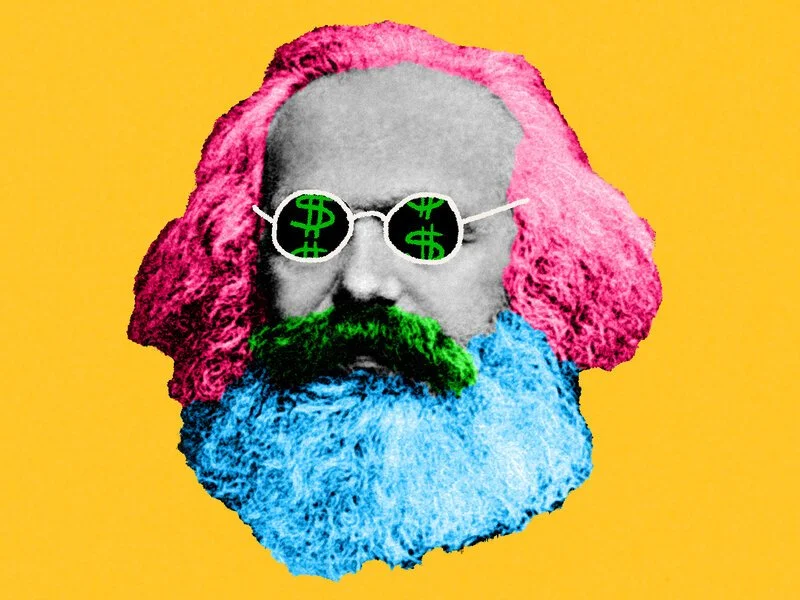
So, Postmodernism was a movement of backlash against Marxism and Socialism (which somewhat hit an ideological dead-end), intellectuals moved away from political engagement, and the role of media in defining reality for us under a fragmenting society became the focus ((i.e. Baudrillard’s “Simulacra and Simulation” in 1981 (which you can read my 3 part series on here) television, etc.)).
Now that we are caught up on the theoretical terms, the overarching argument of The Class Matrix by Chibber is that capitalism’s stability is contingent upon class structure itself, and with a “proletarianized workforce under the Marxist ‘dull compulsion of economic relations’, the system tends toward political stability, not revolution.” This is where Chibber and others argue that Marx was wrong, that maybe an overthrow of the powers that be is not necessarily inevitable both because of and in spite of the fact that “Class is intrinsically exploitative.”(2)
“According to a very powerful line of argument, dominant classes secure their rule by establishing an ideological hegemony, which elicits the consent of subaltern groups[...]The deeper, more fundamental mechanism [the source of consent of the laboring classes] is what I call resignation. Workers submit to capitalism not because they view it as legitimate or just but because they see no real possibility for changing it. Their only reasonable option therefore is to reconcile to it.”(19)
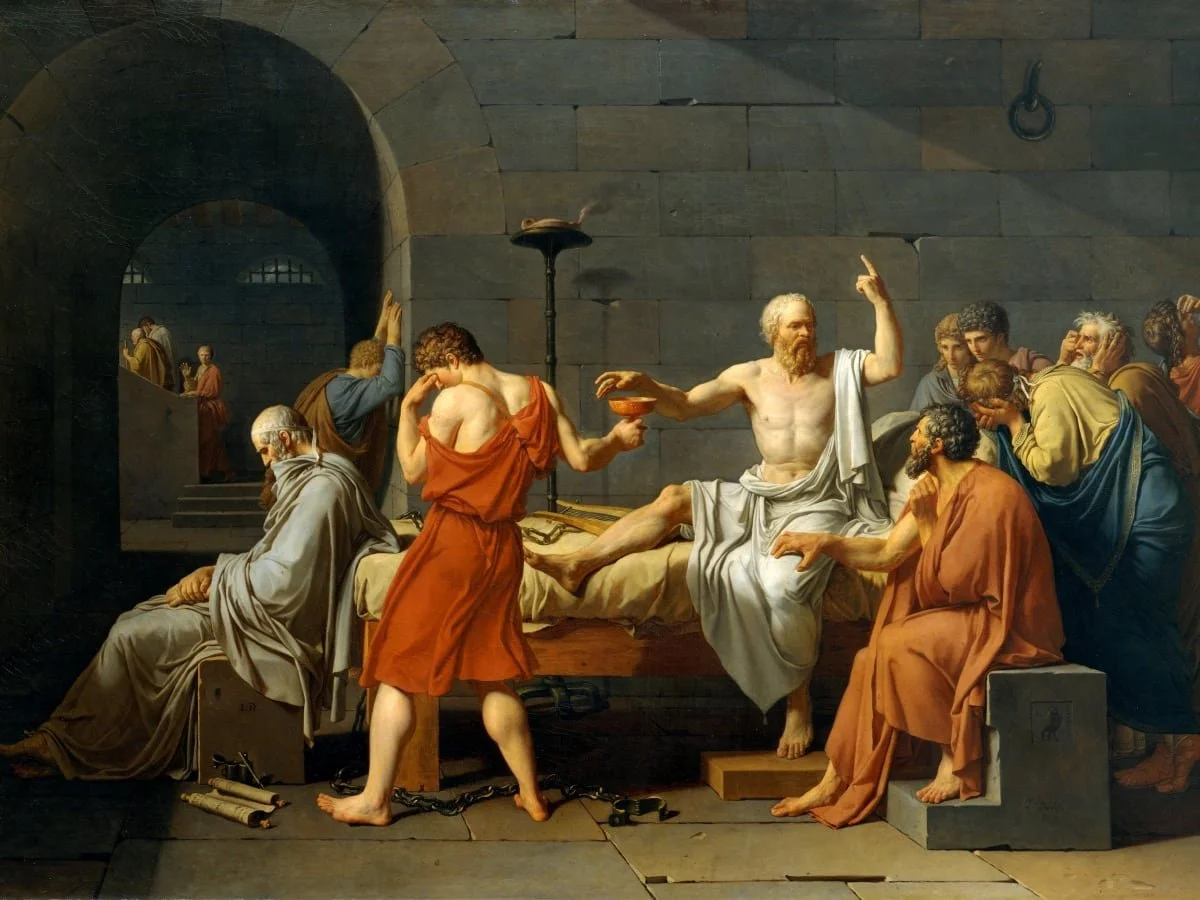
The Death of Socrates by Jacques-Louis David, 1787. This painting famously depicts Socrates about to drink poison hemlock while in prison for “corrupting the youth of Athens by introducing strange gods”, surrounded by his loyal supporters who resign themselves to his fate in grief.
Have you ever heard someone say “welcome to the real world” when you argued that capitalism sucked? That is workers' resignation in practice.
What is the ideological hegemony that capitalism established? The idea of meritocracy as a way to rationalize structural disenfranchisement under the pressures of material circumstances. Proletarian workers are under “economic compulsion”, believing that if they just worked harder or more, they could earn the class mobility that existed before the 1970s, when in reality, “the United States has the most anemic redistributive thrust of any advanced industrial country.”(138)
Wages in the U.S. have stagnated for two generations and the quality of work does not reflect in value/income of labor under capitalism, which is—at its least sinister—an incomplete contract (55).
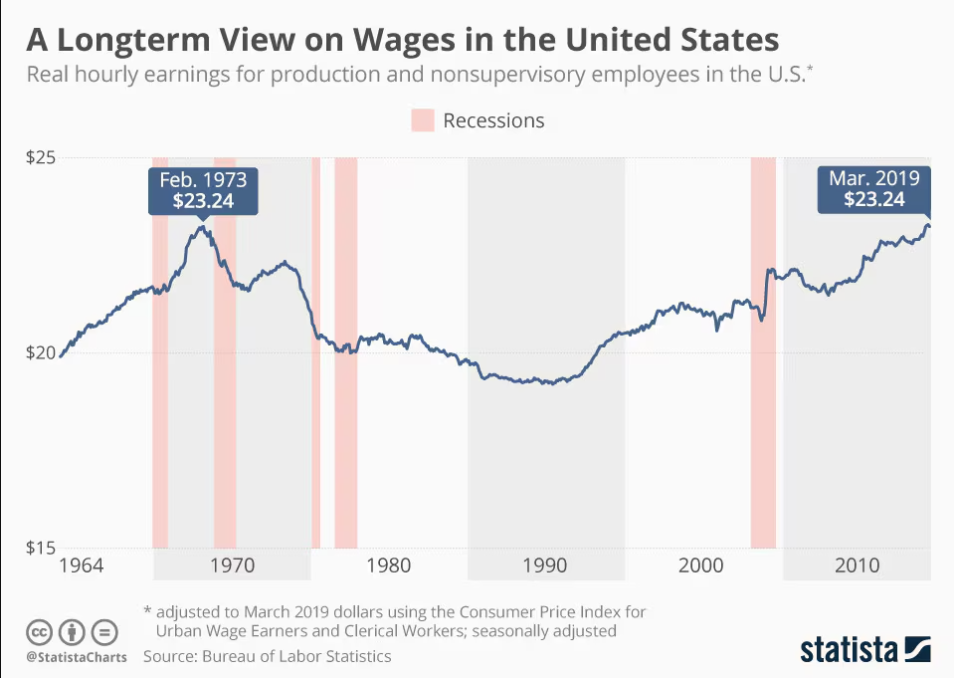
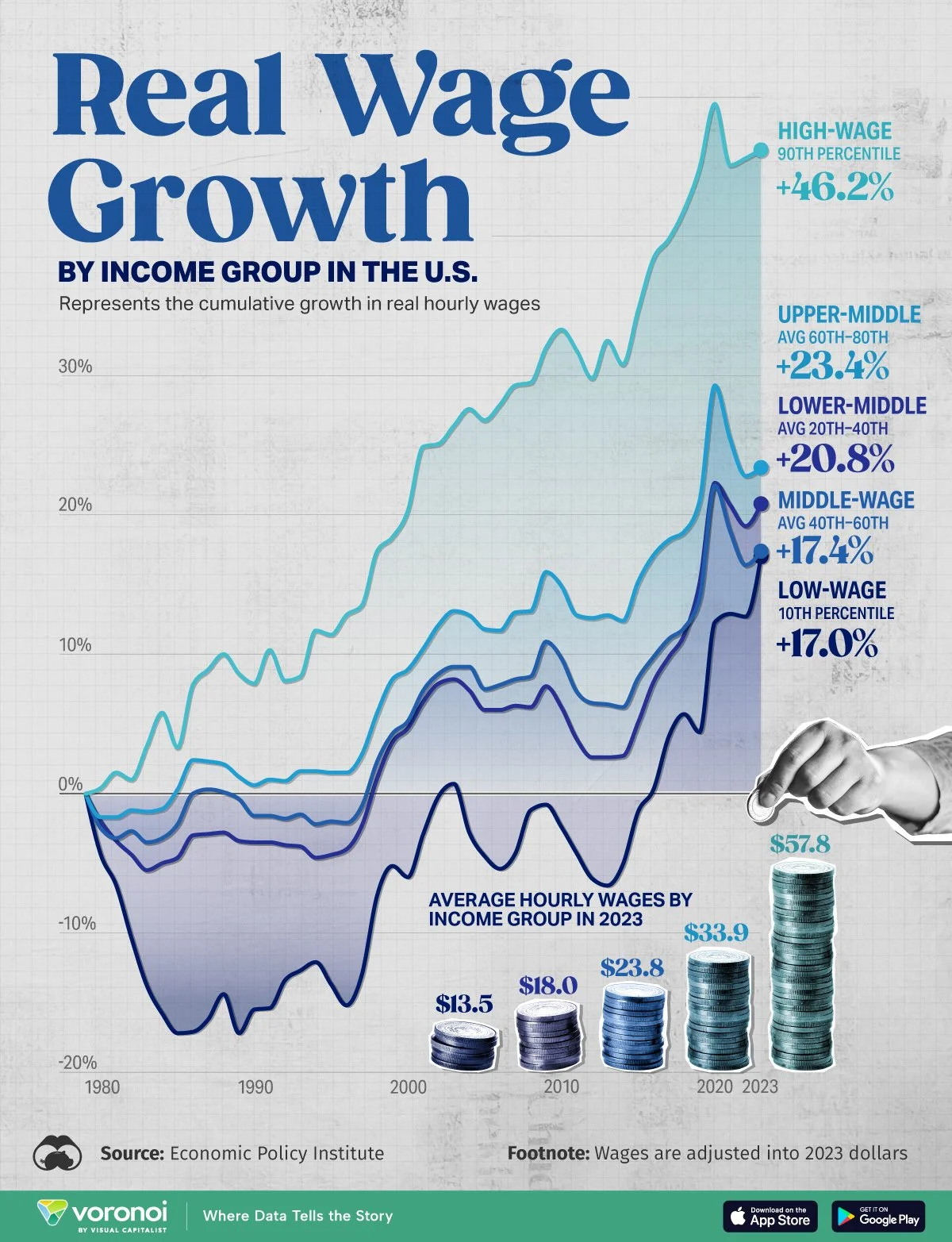
This chart shows US Wage growth from 1979-2023, showcasing how high-income earners had wages grow at over double the rate of middle and low income earners. Income inequality in the US exceeds nearly every other rich nation. “As we can see, the lowest paid workers in America have seen their real wages increase just 17% over the period—averaging a dismal 0.4% annual growth rate. If we take out the pandemic-era’s period of strong wage growth for low-wage workers, this figure drops to 0.1% between 1979 and 2019.”
“It is, of course, true that schools, religious institutions, the media, and the state present the status quo as legitimate; that the poor are socialized into this view of the world; and that dominant classes try to capitalize on their ‘moral and intellectual leadership.’”(90)
Think of the absolutely infantilizing and antagonizing idea thrust upon younger workers by older boomers that "nobody wants to work anymore”. **Eye twitches while laughing maniacally through a 60 hour work week, gainlessly overemployed without hope of ever owning a home in which to display my dust-collecting college degree which has proven useless in terms of class mobility**

“If the working class was to be capitalism’s gravedigger, then how was its ascent, which seemed ineluctable in the century’s early decades, halted by mid-century? And on its heels, how and why did so many workers acquiesce to Reagan and Thatcher, who were so obviously committed to elite interests? Why were workers so attracted to racist and xenophobic ideologies when they were supposed to unite around their common interests?”(3)
Chibber argues that the influence of structural parameters of capitalism are more powerful than culture in terms of influence on economic practice, all while culture is the “causal mechanism that mediates between structure and economic practice”(38). So what culture prompted workers to abandon the labor movements and their asset-poor comrades?
After the 1970s, when close to one-third of humanity was thrown into commodity production which “placed immediate downward pressure on wages across the capitalist world”(11), American workers were increasingly atomized from unions or organized resistance and hung out to dry. Post WWII prosperity and labor movements witnessed the greatest advance in standard of living ever in country’s history, but it all declined from the 1970s onward. (165)
“As employment itself became dispersed and housing radiated outward and beyond city boundaries, work life and social life became even further separated[...]reinforcing the atomizing aspects of the class structure, pulling workers apart instead of pushing them together and, hence, deepening the inclination toward individualistic resistance.”(174-5) This inadvertently fed the socio-cultural phenomena of workers turning against each other, thinking that “they” (whichever choice outgroup is being villainized at the time) are “stealing” all of the “good” jobs, when in reality, neoliberalism and deregulation led to stagnating wages and the economic disenfranchisement of over-privatization.
After political power was captured by the wealthy, asset-owning capitalist elite, the working class became disillusioned. “The essence of my argument is that capitalism does generate a conflict of interests, as Marx argued. And it also motivates workers to resist their domination, again as Marx suggested. But it makes it more attractive to resist that domination on an individual basis, as opposed to a collective one.”(18)
Think of someone you may know who resists. Do they resist by posting online, alone? Think of someone who doesn’t resist, someone who thinks politics don’t affect them, are they doing so with collective backing, or, alone? Individual rebellion is the norm and collective action a deviation (i.e. unions, organizing, protesting, etc.).

Shot from The Breakfast Club, 1985. I thought it fitting since it highlights 80s suburbia, alienation, and individual rebellion.
Something I found extremely compelling about Chibber’s argument was the distinction that despairing resignation to the state of affairs is inherently individualistic, so it may follow that those who have intimate ties to their communities, families, and people who need help are less likely to fall into abandoned hope precisely because doing so means giving up on each other.
“To be sure, significant numbers of working adults have disengaged from the system due to a sense of futility in the face of elite dominance, but opting out is not the same as facing a legal bar. Whereas the latter fueled a sense of outrage and common purpose, the former tends to be more a sign of despair and, hence, individualistic.”(174)
The worst part about it all is that the system survives due to political resignation. “Collective movements require personal insecurity or sacrifice, which is something many people are not willing to give”(66). It is individualism versus solidarity. Don’t tread on me, but do you have a dollar to spare? “Keep government hands off my medicare.” The jokes write themselves.
After over two generations of stagnated wages and less and less of us being able to afford basic living expenses, healthcare, etc., it seems more people are waking up to class consciousness. Bernie famously repeats to his constituency that roughly 60% of Americans live paycheck to paycheck. Chibber explains how there begins an erosion of consent when economic stagnation happens, which is a signal that the dominant class has ceased to play a progressive role (103). It is often the case that systemic consent has to become replaced by coercion (ex: the rise of fascism/authoritarianism *cough cough*).
This leads to the populism that is rising across the western world/global north. “To the extent that members of the class have expressed their discontent, they have done so with the means available to them, and the only such means universally available at present is the ballot box. No wonder, then, that the discontent has tended to be electoral in form and that the explosion has been populist in content, whether on the left or right. The new populist wave of the past decade is the new face of working class rebellion today.”(176)
Overall, I found Chibber’s arguments compelling and written in an easily-digestible way for someone who is now outside of academia (Chibber is a Sociology professor at NYU). The only gripe I have with this book is that it fails to establish ways in which the working class could effectively organize with examples from the past or similarly oriented countries, though instructive or suggestive ideating on political action doesn’t seem to be his intention with The Class Matrix. On the podcast Jacobin Radio, Chibber tends to dissect the ways in which the strong political left waned after the 70s, leading to a floundering Liberal Democratic party without a clear mission, which should arguably have been shoring up the working class this entire time.
Either way, this book helped me understand a bit more about the political narrative of capitalism over time, from post-70s era America onward.
A recent interview with Vivek Chibber on Doomscroll that I think is worth watching/listening to.

Click the image to go to Doomscroll
Ways we can help each other build a better tomorrow:
Join your local Indivisible chapter
Volunteer at a food bank, women’s shelter, etc.
Run or support someone running for local office, grassroots
Vote in Municipal elections (most counties hold them on odd-numbered years like 2025, here are North Carolinas)
Thank you for reading, I am a learning, imperfect human. If you find any factual errors, confusions of argument or definitions, please comment below so we can help each other learn! - Gab